31/07/2026
Associate Professor A. Doruk Günaydın, a faculty member at Sabancı Business School, Sabancı University, focuses his research not on predicting “which stock will rise,” but on understanding which risks and firm characteristics are rewarded with higher returns. Günaydın received this year’s BAGEP Award, presented by the Science Academy (Bilim Akademisi) to outstanding young scientists, for his work on the distinction between risk and uncertainty. He also notes that a strong investment signal can sometimes arise from human emotions rather than numbers.

Günaydın’s interest in finance dates back to childhood, and he has pursued this passion with determination. After earning his bachelor’s degree in Electronics Engineering from Sabancı University, he shifted his career toward finance. He then completed a master’s degree in Mathematical Finance at Boston University and a PhD in Finance at Sabancı University, deepening his academic expertise in the field. Today, he continues his academic career as a finance scholar conducting research at the international level. Dr. Günaydın, who returned to Türkiye in 2010, says he chose Sabancı University because of its strong academic foundation.
Center of Excellence in Finance - CEF
Günaydın teaches at both undergraduate and graduate levels and is also active within Sabancı University’s Center of Excellence in Finance (CEF). He contributes to CEF’s educational activities by developing content on current topics such as artificial intelligence, sustainable finance, and portfolio management. This content is shared on the center’s YouTube channel.
(Educational videos by Assoc. Prof. Doruk Günaydın on portfolio management and finance are available on the Center of Excellence in Finance YouTube channel.)

Research Highlights
*The difference between risk and uncertainty
Dr. Günaydın, recipient of the Science Academy’s 2026 BAGEP Award, describes the research project for which he received the award as follows:
“At the heart of my research program lies one of finance’s most fundamental distinctions: the difference between risk and uncertainty. This distinction dates back to the work of economist Frank Knight in 1921. According to Knight, risk refers to situations in which probabilities are known. For example, when you roll a die, you do not know which number will come up, but you know that each number has a one-in-six chance of appearing. Insurance companies are able to price precisely these kinds of risks because they can measure them.
Uncertainty, by contrast, refers to situations in which even the probabilities are unknown. The investor does not even know how many sides the die has, let alone which numbers appear on it. The first weeks of the pandemic, the outbreak of major wars, or tariff decisions announced overnight are examples of this type of uncertainty.
Both risk and uncertainty affect pricing in financial markets. Investors require a higher expected return not only for holding risky assets, but also for holding assets subject to high uncertainty. In the finance literature, this behavior is known as ‘uncertainty aversion’.
The research I am conducting under BAGEP examines uncertainty along two dimensions. The first is systematic uncertainty, which affects the entire market and may arise from wars, pandemics, or sudden policy changes. The second is firm-specific uncertainty, which affects only a particular company and may arise from a major lawsuit or an untested technology. We can think of the first as fog descending over an entire city, and the second as fog surrounding a single building.”
*The delayed impact of bad news
Dr. Günaydın explains that the conceptual foundations of his uncertainty project build on two earlier studies on the pricing of losses:
“Our study, ‘Left-tail momentum: Underreaction to bad news, costly arbitrage and equity returns,’ published in the Journal of Financial Economics in 2020, began with the following question: Why do some stocks fall much more sharply than others when the market declines, and what happens to those stocks afterward? The term ‘left tail’ refers to the most adverse outcomes in the return distribution.
Our findings show that stocks that have suffered large losses in the recent past continue to underperform their peers in the following period. Under the efficient markets hypothesis, however, bad news should be incorporated into prices quickly. Our findings instead suggest that investors are slow to absorb bad news. One reason is that investors are reluctant to sell at a loss. Another is that these stocks are costly to short, limiting professional investors’ ability to correct the mispricing. As a result, prices may continue to decline for longer than expected. In short, markets do not always price in bad news immediately, and yesterday’s biggest losers often remain tomorrow’s losers.”
*The risk appetite of wealthy investors
Dr. Günaydın explains that his research on the pricing of losses naturally raised a second question:
“Who are the investors driving these prices? Our study, ‘Do the rich gamble in the stock market? Low risk anomalies and wealthy households,’ published in the Journal of Financial Economics in 2023, offers a new explanation for the low-risk anomaly, one of the most important puzzles in finance. According to financial theory, higher risk should be compensated by higher expected returns. Yet decades of evidence show that low-risk stocks can earn higher returns over the long run.
We sought an answer to this puzzle in Sweden’s unique household-level data. Sweden is one of the few countries where household portfolios are recorded at the individual-stock level. Thanks to our coauthor at the Riksbank, Sweden’s central bank, we were able to examine the investment choices of millions of households.
Our findings show that wealthy investors have a marked preference for lottery-like stocks: risky stocks that offer a small probability of a very large payoff. This demand pushes up the prices of those stocks and lowers their expected future returns. Although gambling behavior is more commonly associated with lower-income investors, the data show that wealthy investors with large portfolios can behave similarly and exert a significant influence on market prices.”
*The return to regret
Dr. Günaydın continues his research in behavioral finance with the article ‘Regret in global equity markets,’ published in the International Review of Financial Analysis in 2025. Together with his coauthors, he examines regret, one of the most human emotions in finance, from a global perspective.
“Even if the stock you own has made money, you may still feel regret if a comparable stock has performed much better,” says Dr. Günaydın. Using data from numerous countries, the study shows that the regret effect is a global phenomenon.
The findings indicate that stocks that generate greater regret among investors tend to earn higher returns in the subsequent period. This effect is particularly pronounced in emerging markets and in countries with greater limits to arbitrage.
*Pricing climate risk
Another branch of his research program focuses on one of the greatest sources of uncertainty of our time: climate and the environment. Dr. Günaydın asks: “Do the stocks of polluting companies earn higher returns?” Based on his research, his answer is: “Previous studies interpreted the higher stock returns of companies with high carbon emissions as evidence that markets were pricing climate risk. Our study, however, shows that these higher returns stem not from the pricing of risk, but from these companies reporting higher-than-expected profits. This has an important policy implication: since markets do not automatically penalize polluting companies, the transition to a low-carbon economy cannot be left solely to market forces. Regulation and public policy have a critical role to play.”
*The impact of artificial intelligence
Today, artificial intelligence is affecting every discipline, and financial markets are no exception. Dr. Günaydın identifies three key lessons: “First, beating the market is difficult even for professionals. Second, the mere claim that a model or investment product uses artificial intelligence is not enough. Third, outcomes depend not only on the model itself, but also on how it is used, how it is tested, and how investors behave. We should therefore neither underestimate artificial intelligence nor exaggerate its capabilities. Financial markets may indeed contain relationships that conventional methods fail to detect. Artificial intelligence can be a powerful tool for uncovering them, but experience also teaches us that a powerful tool does not necessarily produce powerful results when used incorrectly. More data, more complex models, and more advanced algorithms are not sufficient on their own. The quality of the data, the way the model is tested, the way the strategy is implemented, and the way investors respond to that strategy are at least as important as the model itself. Artificial intelligence in finance is not an overhyped promise. It is a concrete reality that is changing the rules of the game. We will benefit from it most when we use it not as an all-knowing crystal ball, but as a powerful lens that helps us see complex markets more clearly and sharpen our strategies.”
https://www.youtube.com/watch?v=jfaGDifp6CQ
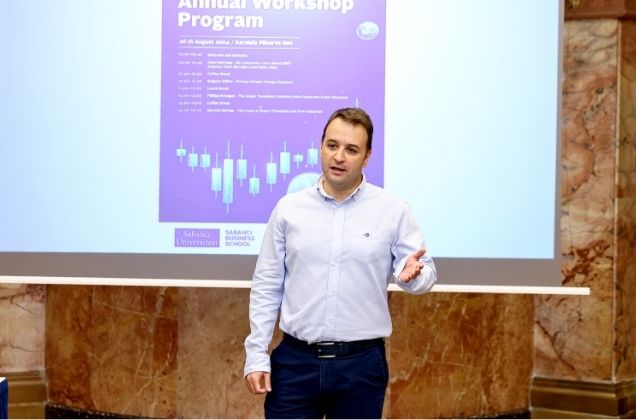
Who is Assoc. Prof. Doruk Günaydın?
Assoc. Prof. Doruk Günaydın received his bachelor’s degree in Electronics Engineering from Sabancı University in 2009, his master’s degree in Mathematical Finance from Boston University in 2010, and his PhD in Finance from Sabancı University in 2016. After completing his doctoral studies, he joined the faculty of Sabancı Business School that same year. He became an associate professor in 2023.
Günaydın’s research interests include asset pricing in international markets, the determinants of stock returns, household finance, and the effects of downside risk on returns. His research has been published in prestigious international journals, including the Journal of Financial Economics, the Journal of Portfolio Management, and the Journal of International Money and Finance.
He also develops educational content on portfolio management and asset pricing through the Center of Excellence in Finance (CEF).
https://www.youtube.com/c/CenterofExcellenceinFinance
https://www.sciencedirect.com/science/article/pii/S0304405X23001551
https://www.sciencedirect.com/science/article/pii/S0304405X19301795
https://www.sciencedirect.com/science/article/abs/pii/S1057521925002856